
 19th February 26
Developing SparkSpace: A collaborative, co-creative process
Right from the start, SparkSpace has been about co-creating with children and young people, alongside library representatives and our members, with expert external partners and with the Libraries Rising team itself.
That approach was completely deliberate.
Because before we began developing SparkSpace, we asked ourselves a simple question: who’s not in the room?
This question probably isn’t an unfamiliar one. It (rightly) casts a light on a common problem; lack of representation and diverse thinking in decision-making spaces. At Libraries Rising, it’s a question we take seriously and want to place at the heart of our organisation.
One group is frequently missing from the room: children and young people. This is despite the fact that it’s their right (under the UN Convention on the Rights of the Child) to ‘express their views, feelings and wishes in all matters affecting them’. Only about one in five children and young people feel that the adults running the country are listening to them, according to a recent survey carried out by the Children’s Commissioner.
Libraries Rising focuses on creating libraries of tomorrow with children and young people today; the key word being with, not ‘for’, or ‘on behalf of’. That was our starting point for developing SparkSpace: a learning module and toolkit for the whole library workforce, including volunteers. Children and young people’s views, feelings and wishes needed to sit at its heart. Exactly what that would look like was something we would shape together along the way.
A note on co-creation
Our initial plans for SparkSpace were fully driven by the evidence given to us by libraries. Through our Youth Engagement Network, we found that 100% of library teams involved in a co-creative approach could see the value of it, but that they found it challenging to spread the learning more widely across their workforce. Children and young people valued the approach too, with 100% of pilot participants saying they felt their opinions, thoughts and ideas were listened to.
Feedback from our members reinforced what we were hearing: connecting with children and young people was a top priority, but confidence levels, especially when working with teenagers, were often low.
In short, when developing plans for SparkSpace, we never presumed we ‘knew best’. It was entirely shaped entirely by feedback, suggestions, and ideas from the people who would use it, and those it was designed to benefit.
Step 1. Securing the right partner for SparkSpace
We secured funding from the Foyle Foundation to develop SparkSpace, and one of the first steps was to ensuring we had the right team in place. Our tender process for an external partner focused not only on bringing children and young people’s ideas and opinions to the heart of SparkSpace’s development, but also highlighted the importance of a diverse range of young voices, with different lived experiences and geographic locations represented.
We also recruited the right freelance project manager, marketing expert and learning platform developer; all experienced in collaborative work and fully committed to the vision behind SparkSpace. We had a number of impressive responses to our tender, all showing strong expertise and respect for working with young people. We chose Participation People due to their relationships with children and young people across the country, and for their interactive and often playful approach, because co-creation tends to be that much more impactful if it’s driven by positivity and joy.
Supporting them were Farrell Renowden, project manager, (who has a formidable background working with charities and indeed libraries), marketing consultant Bryony Bishop (whose support with Libraries Rising’s recent rebranding and marketing ensured she had excellent understanding of our approach), and Agency for Good (a website development agency who have considerable experience working flexibly with charities). Together, we had a team of collaborative, proactive experts to deliver SparkSpace with us.
Step 2. Working with children and young people
At the heart of co-creating library services with children and young people was the commitment to genuinely share power in the process.
The children and young people were located across the country, so we ran a series of online sessions facilitated by Participation People. Library members and representatives joined these sessions too, ensuring their feedback and opinions were heard.
The sessions were fast-paced, exploratory and a lot of fun. At first, so many ideas emerged that the process felt huge and a little tangled which is of course, classic co-creation in action. However, as the sessions continued, ideas were tested, discussed, and refined, with children and young people very much driving this forward.
The resulting development of the learning content was an iterative process; again, with young people closely involved at every stage. They even led the creation of video content for the platform. Members were invited to test and provide feedback along the way. They offered practical, insightful input that was vital to getting SparkSpace right.
Step 3. Keeping to a tight timeline
With just six months to develop and deliver SparkSpace, having a proactive project manager was essential. Farrell attended sessions with children and young people to understand our goals and created a detailed timeline to keep the project on track.
When co-creating, it’s easy for timelines to slip, which isn’t always a problem when building strong, trusting relationships. In this case, however, we needed someone to keep us on track without compromising the integrity of the work.
Step 4. Amplifying SparkSpace
Communication is a key aspect of co-creation. We wanted SparkSpace to reach the people who could benefit most, and to make sure the wider world understood the vision behind the learning platform and toolkit.
Bryony Bishop developed a comms plan, which Charlotte, our Communication and Impact Manager, picked when she joined Libraries Rising. They coordinated announcements, updates, and materials to keep members and library teams informed and engaged throughout the project. We also worked with Lorna Harris, a PR expert who helped position SparkSpace on a national stage.
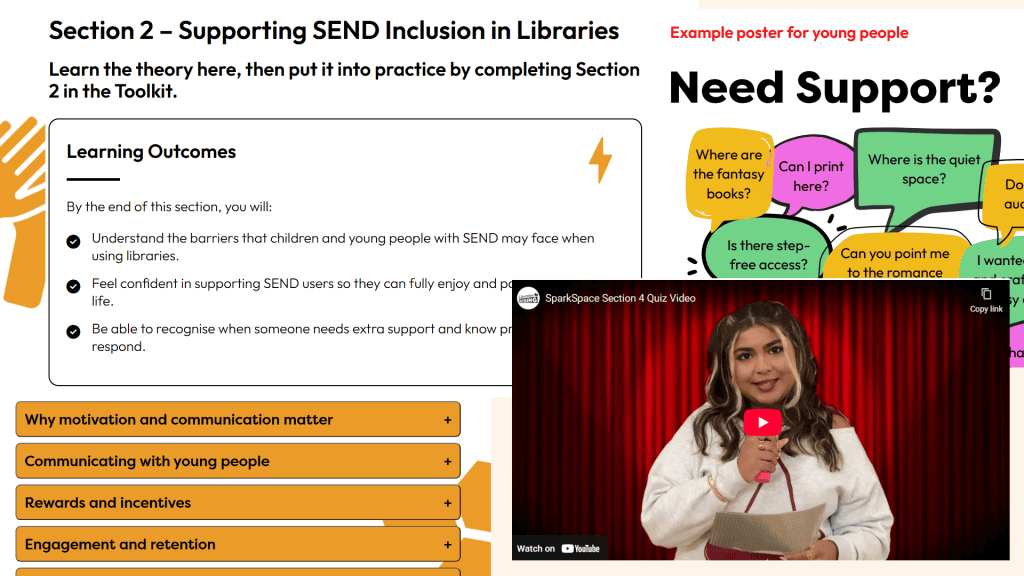
Through these combined efforts, we amplified SparkSpace not just as a learning resource, but as an example of what co-creating library services with children and young people can achieve. The communications ensured the insights, stories, and tools developed could inspire and support library teams across the country.
Written by Lucy Banks, Programme Manager
SparkSpace is the first training platform co-created with young people to support library professionals and volunteers to meaningfully engage young people within their services. Completely free to use, it offers practical, hands-on learning, including videos, quizzes, and a toolkit of activities that can be applied directly into library services.